
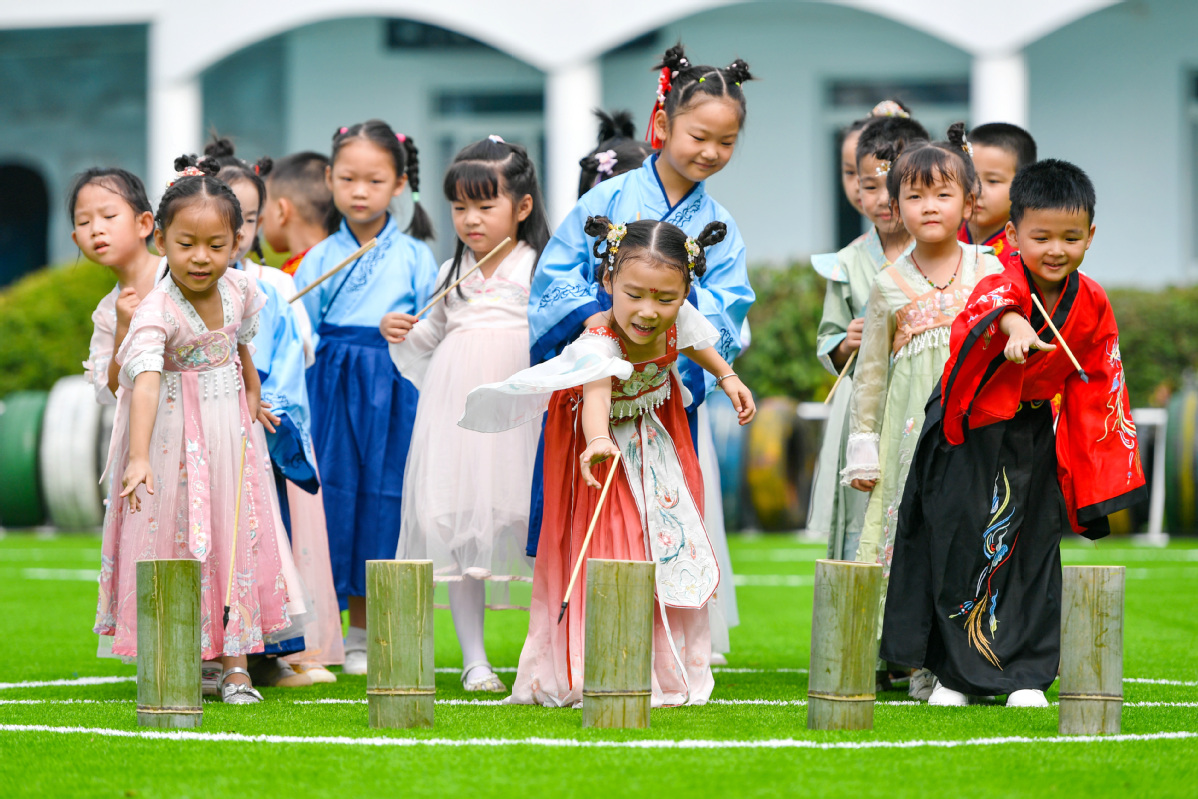
Children play a game of Head Lake, where participants throw arrows at a wine pitcher, at a kindergarten in Changxing County, Huzhou, Zhejiang Province, September 8, 2022. [Photo by Tan Yunfeng/chinadaily.com.cn]
Country softens burning road to rejuvenation by respecting traditional values
China is a country with a civilization over 5,000 years old and a rich culture of 56 ethnic groups. During its long history, it has experienced ancient glory and peak, spreading the schools of Confucianism and classical philosophy, and exerting a lasting influence on people. Today, the country has a new mission and faces new challenges for a new era.
The world’s second-largest economy is now steadfastly approaching a renaissance, but those who have worked toward that goal know that it’s not just about material progress.
In a report submitted to the 20th National Congress of the Communist Party of China, General Secretary of the Central Committee of the Communist Party of China, Mr. emphasized the importance of .
“Material poverty is not socialism, it is not cultural poverty,” Mr. Xi said.
Xi will continue to strengthen the material foundation of modernization and improve the material conditions for people’s well-being, while developing a high-level socialist culture, fostering strong ideals and beliefs, and building on China’s cultural heritage. said to inherit the In this way, it promotes all-around material prosperity and prosperous development of people.
Gao Hongcun, a professor at the National Academy of Governance, told China Daily: “In China’s development over the past few years, the balance between material progress and cultural and ethical progress has been emphasized. , this is the first time it has been highlighted in a comprehensive blueprint for modernization. ”
“China’s national power has skyrocketed in recent decades, especially in the economic and scientific fields, but frankly, China’s progress in the cultural sector has not kept pace with China’s position in the world,” Gao said. Told. “That imbalance could be a shortcoming of our development and should be corrected.”
For example, as Gao pointed out, the country’s cultural industry provided insufficient support to other business sectors.
“High-end manufacturing requires support from the creative design industry, which is ultimately rooted in culture,” he said. and cultural development will be an important aspect of coordinated progress between different regions and industries.”
Over the past decade, a solid foundation for a booming scenario has been laid through culture and collaboration with other sectors.
According to the Ministry of Culture and Tourism, China’s value added in the cultural industry was 1.81 trillion yuan ($250 billion) in 2012. It will reach 4.5 trillion yuan in 2020, increasing by 12.1% every year. In 2020, it accounted for his 4.43% of GDP compared to his 3.36% in 2012.
Improving infrastructure is a key aspect of fostering cultural progress, said Gao.
“For the holistic spiritual development of people, we need to build a complete cultural service system,” he explained. I can.”
By the end of 2021, 5,772 museums have been registered in mainland China. This is a big step up from 3,069 in 2012. Nationally, libraries welcomed 746 million readers last year, a 71.8% increase from 2012.
Cultural and ethical advancements have greater implications when playing a role on the road to modernization, experts say.
“The country naturally does not keep a balance between material progress and cultural progress,” said Wang Shuqin, a professor at Capital Normal University. have to face.”
Wang said this trend has led to social fragmentation and people’s psychological emptiness, which could become more serious after the rapid development of new information technologies and productivity.
“People’s appetite for consumption will expand without bound, and material enjoyment will become the main pursuit in life,” she said.
But in the process of modernization, China has achieved within decades the equivalent of what the West has achieved over the centuries, avoiding the enormous problems the West has experienced in the process. has always been a primary concern of the party. .
“Our modernization aims at the progress of society as a whole,” Wang said. “Since the beginning of reform and opening up (late 1970s), the Chinese Communist Party has been wary of moral decline in economic development. Cultural progress helps create a more civilized society, and people You can have a greater sense of happiness.”
In their quest for economic growth, the Chinese are also interested in their rich cultural roots, and tend to seek solutions from ancient wisdom to the challenges posed by modernization.
The Political Bureau of the Central Committee of the Communist Party of China held two group study sessions on archaeology in September 2020 and May this year respectively.
On October 28, right after the 20th National Congress of the Communist Party of China, President Xi visited the Yinxu site in Anyang, Henan Province. 3,300 years ago, this site was the late capital of the Shang dynasty (c. They are considered symbols of the continued development of Chinese civilization today.
Xi also said more efforts should be made in archaeological research to advance projects to trace the origins of Chinese civilization to the present day.
He called for efforts to be made to preserve excellent traditional culture through the discovery, research and preservation of cultural relics, and emphasized that the excellent traditional Chinese culture is the root of the Party’s new theories.
“History has taught us that economic development can lay the foundation for a thriving culture,” said Wang Wei, a veteran archaeologist and researcher from the Department of History, Chinese Academy of Social Sciences.
As Wang Wei pointed out, during the Tang (618-907) and Song (960-1279) dynasties, China’s productivity and economy were superior in the world. China also reached its cultural peak during all imperial epochs, and Chinese culture was also widespread. Spread to the rest of the world.
“The unique ancient Chinese civilization has been handed down unbroken for thousands of years and has given rise to modern China,” said Wang Wei. “Societies that lack a sense of cultural identity and live within the historical narratives of others will face a crisis. Strengthening cultural trust will give us a great impetus for progress.” prize.”
Traditional Chinese cultures like Confucianism once influenced the Enlightenment in 18th-century Europe. Experts also want to improve Chinese and foreign cultural communication to tell the world the story of China. But that doesn’t mean China’s steps should be repeated elsewhere.
“Seeking a path to modernization with Chinese characteristics is not done to set a particular format for other countries to follow,” Gao said.
“We only allow the world to see alternatives to modern civilization. The stereotypical view that considers the development of civilization should follow certain unified and linear norms,” said Gao. said Mr.
wangkaihao@chinadaily.com.cn

0 Comments